Choosing a green hotel carpet requires two separate decisions: the shade guests will see and the construction that will withstand traffic, cleaning and replacement demands. By comparing colour, zoning, fibre, construction, installation evidence and environmental documentation, you can create a specification that looks luxurious without treating appearance as proof of performance.
Key takeaways
- Use sage in bright guest areas and forest green in formal spaces.
- Match green carpet to daylight, lighting temperature, finishes and hotel branding.
- Specify durable construction for corridors, restaurants and other high-traffic zones.
- Test samples for colour shift, wear, stains, cleaning and environmental documentation.
Which green shades suit each hotel area?
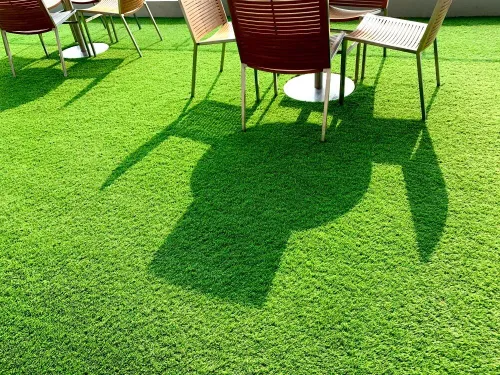
Sage and muted grey-green make hotel spaces feel calm and more open; forest and emerald create depth, ceremony and stronger visual identity. Choose by zone before choosing one property-wide shade, because guest rooms, corridors, restaurants and ballrooms do not receive the same traffic or light.
| Shade | Appearance and atmosphere | Suitable hotel areas |
|---|---|---|
| Sage | Airy, restful and softly contemporary; pale versions reveal soil and luggage marks sooner | Guest rooms, spas and quiet lounges |
| Muted grey-green | Understated, spacious and easy to pair with stone or grey upholstery | Conference rooms, lift lobbies and modern reception areas |
| Olive | Warm, grounded and less stark than pure green; disguises moderate tracking | Corridors, restaurants and business lounges |
| Moss | Natural, textured and welcoming, with good visual depth when patterned | Guest corridors, dining areas and informal lounges |
| Forest | Dark, intimate and premium, but it can reduce the perceived width of a narrow corridor | Luxury lounges, bars and reception feature zones |
| Emerald | Jewel-like, energetic and memorable; use it as a focal colour rather than background everywhere | Boutique reception areas, restaurants and ballroom accents |
| Teal-green | Cooler and more urban, linking green with blue for a polished atmosphere | Conference rooms, lift lobbies and contemporary guest rooms |
Approve green carpet for hospitality from full production samples under the hotel’s actual LED, daylight and warm decorative lighting. Olive, sage, forest and emerald can shift noticeably between sources, so a digital image or small showroom swatch cannot establish the installed colour.
Among hotel carpet colour options, a patterned mid-tone green usually hides tracked dirt and uneven wear better than a pale, solid sage. Use carpet tiles in corridors when local replacement matters; choose broadloom where continuous luxury appearance matters more.
Match the carpet to light, finishes and hotel branding
Approve the carpet from a full production sample under the hotel’s daylight, LED and warm decorative lighting before matching finishes. Sage and grey-green can look washed out beside cool white LEDs, while olive or emerald can become yellow or overly intense beneath warm lamps. A digital image is not a colour decision.
| Element | Coordination choice | What to check |
|---|---|---|
| Paint | Use warm white, sand or soft greige with yellow-green carpets; use pale blue-grey with cooler greens | Test wall paint beside the carpet, not separately |
| Wood | Pair olive and moss with oak or walnut; use forest green with lighter wood | Dark wood plus dark carpet can shrink corridors visually |
| Stone | Limestone, terrazzo and pale marble keep green areas open | Busy stone needs a quieter carpet pattern |
| Metal | Brass and bronze reinforce warm greens; brushed nickel suits grey-green and teal | Match metal samples under installed lighting |
| Upholstery and curtains | Repeat the carpet’s undertone, not its exact colour | Exact matching can look artificial and exposes dye-lot differences |
| Brand colours | Echo one brand accent in cushions, signage or piping | Do not force a green that clashes with the identity palette |
For dirt and wear control, choose a mid-tone or subtly patterned green for corridors, lift lobbies and restaurants; pale solid green shows tracked soil and luggage marks quickly, while very dark green reveals lint and vacuum bands.
Confirm the maintenance plan before ordering: entry mats, vacuuming, spot treatment and extraction frequency affect appearance as much as fibre durability.
A search for hotel carpet colour options or “green carpet shop in south in delhi” must also state whether green means colour or environmental credentials; colour alone proves nothing about recycled content, emissions or life-cycle impact.
Choose the construction by traffic zone
Start with the traffic map, not the colour sample. Guest rooms, corridors, lift lobbies, restaurants, ballrooms and back-of-house routes need different constructions. The search terms luxury carpets in delhi and luxury carpets for hotels describe appearance, not suitability.
| Option | Best hotel zone | Why |
|---|---|---|
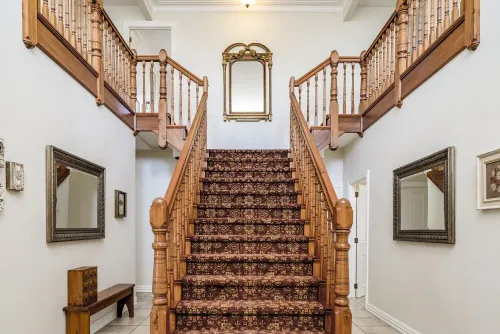
| Broadloom | Lobby, suite, ballroom and quiet guest-room areas | Creates a continuous surface with fewer visible joints; local damage can require a larger cut-out and colour match. |
| Carpet tile | Corridors, lift lobbies, meeting spaces and busy routes | Lets you replace stained or worn tiles locally; keep spare tiles from the same dye lot. |
| Loop pile | Corridors, restaurants and entrances | Resists crushing and shows less tracking; avoid loose loops where luggage wheels or snagging are concerns. |
| Cut pile | Suites, lounges and reception areas | Gives a softer, more luxurious appearance, but flattened traffic lanes show sooner. |
| Patterned carpet | Corridors, lifts and restaurants | Breaks up luggage marks, soil and uneven wear better than a plain field. |
| Plain carpet | Suites, spas and restrained luxury schemes | Gives visual calm, but every spill and traffic path is easier to see. |
| Wool | Lobby, suite and lounge where touch, appearance and repair service matter | Offers a premium finish; confirm stain treatment, maintenance capacity and traffic testing. |
| Synthetic fibre | Corridors, meeting rooms and high-turnover operations | Usually simplifies cleaning and replacement; specify tested commercial performance rather than relying on “commercial” wording. |
For heavy-use zones, request the tested product classification; EN 1307 Class 33 indicates heavy commercial use. Check that the classification covers the exact construction and custom colour, not merely the product family. A luxury face is no substitute for seam, backing and castor-chair performance.
Test green carpet for hotel-grade performance
A “commercial” label is not enough for a hotel corridor. Request the tested construction, colourway and backing, because a custom green carpet is not automatically covered by the rating of the standard range.
EN 1307 Class 33 is the heavy-commercial classification to look for, while pile weight, tuft density, gauge and total thickness reveal how much material supports the face.
| Document | Ask for | Why it matters |
|---|---|---|
| Commercial performance | EN 1307 classification, use class, pile weight, tuft density and backing specification | Confirms whether the exact product suits rooms, corridors, lobbies or back-of-house traffic |
| Wear and appearance | Abrasion method and result, castor-chair test, dimensional stability, stain-resistance test, and colourfastness to light and rubbing | Prevents premature thinning, wheel damage, stains and fading at windows or entrances |
| Health, acoustic and safety | Complete assembly emissions declaration for carpet, cushion, adhesive and seam sealer; acoustic test to ISO 354 or ISO 11654; slip-resistance result | The installed system, not the face fibre alone, determines indoor-air and sound performance |
| Installation and care | Floor-preparation limits, adhesive, seam and edge details, warranty, cleaning schedule, approved spotters and replacement procedure | Bad preparation causes open seams; unsuitable chemicals create discolouration |
Ask GALICHA HOUSE PVT LTD to mark samples for each zone and supply these records before approval. For luxury carpets for hotels, compare visual finish separately from corridor durability. A green carpet for hospitality also needs an agreed soil-control plan: entry mats, vacuum frequency, extraction intervals and stain-response times.
Pale solid green demands faster intervention than a patterned mid-tone.
Related products
 | Hotel Carpet Hotel Carpet Hotel Carpets by Galicha House Pvt. Ltd. Enhance the elegance, comfort, and sophistication of your hospitality spaces with premium Hotel Carpets from... |
 | Green Carpet Green Carpet Green Carpets by Galicha House Pvt. Ltd. Bring freshness, elegance, and a touch of nature into your interiors with Green Carpets from Galicha House... |
Separate environmental claims from appearance and know when to change colour
A request for “green carpet” needs clarification: do you mean green-coloured flooring or environmental performance? “Green carpet shop in south in delhi” describes colour, not proof of recycled content, emissions or life-cycle impact. The phrase “green carpet shop in south luxury carpets in delhi” needs the same distinction.
Ask for three separate evidence sets: a product-specific emissions document, verified recycled or bio-based content, and a whole-product life-cycle assessment such as an Environmental Product Declaration. CRI Green Label Plus addresses low chemical emissions from carpet and adhesive systems; it does not certify recycled content or whole-life carbon.
Agree the maintenance plan before approving the sample. Specify entry mats, soil-control measures, vacuuming, interim cleaning, extraction frequency, approved spotters and stain-response times. Pale green solid carpet demands stricter appearance control than a patterned mid-tone with similar structural durability.
Record the approved control sample, dye-lot tolerance, production batch quantity, replacement-stock requirement and the installed location of each lot. Without those records, a later repair can be structurally correct yet visibly mismatched.
| Option | Choose it when | Main advantage over green |
|---|---|---|
| Charcoal | Corridors show luggage marks, soil or uneven wear | Conceals traffic better |
| Taupe | Guest rooms need warmth without a strong colour commitment | Coordinates with wood, stone and changing décor |
| Navy | Branding is formal and the space has sufficient light | Gives depth and hides dark marks |
| Patterned neutral | Meeting areas need longer visual freshness | Masks stains and replacement variation better than a pale solid green |
Frequently asked questions
Which green carpet shades suit different hotel areas?
Use sage or muted grey-green for calm, open guest rooms and bright areas. Choose forest or emerald green for corridors, lounges, restaurants and ballrooms that need depth and stronger identity.
How should hotel carpet colour match lighting and finishes?
View samples under the actual daylight and electric lighting, then compare them with wall paint, timber, stone, metal finishes and the hotel brand palette. Green can shift noticeably between warm and cool light.
Which carpet construction suits each hotel traffic zone?
Specify construction by use: guest rooms need comfort and stain resistance, while corridors, entrances and restaurants need stronger pile retention, seam performance and cleanability. Ballrooms need durability that also supports the intended visual finish.
How can you test green carpet for hotel-grade performance?
Approve a full-size sample in the proposed area and check colour under operating light, pile recovery after pressure, seam visibility, stain removal, cleaning compatibility and backing stability.
Do environmental claims prove that a green carpet is sustainable?
No. Separate the carpet’s visual colour from claims about recycled content, fibre sourcing, manufacturing and end-of-life recovery. Ask for named certifications or written material documentation instead of relying on the word green.
Keywords