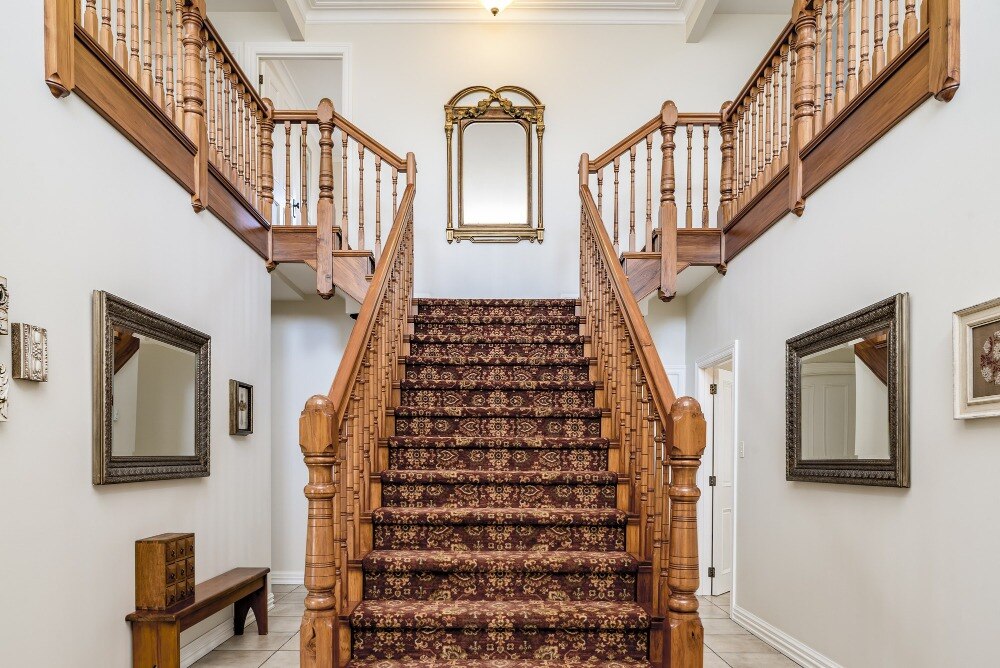
A stair carpet quote is incomplete if it says only “premium,” “luxury,” or gives a floor-area price. You need construction data, accurate stair measurements, an installation method, safety details and a written breakdown of every cost before approving the carpet.
Key takeaways
- Request pile, backing, fire rating, slip resistance and installation limits on the datasheet.
- Measure every tread, riser, landing and waste allowance before ordering stair carpet.
- Match pile height, underlay and fixing method to the stair profile and traffic level.
- Approve a full-width sample for colour, pattern direction, safety and edge finish.
Which technical specifications should appear on the carpet datasheet?
A usable stair-carpet datasheet must describe construction, performance and installation limits, not merely call the product “luxury carpets for staircases.” Ask the shop to state:
- Fibre composition and blend percentages; tufted or woven construction; cut-pile or loop-pile surface.
- Pile height, total thickness, pile weight and total weight per square metre. Face weight alone does not prove quality because density also depends on pile height.
- Primary backing, secondary backing and tuft-bind information.
- Intended-use classification under EN 1307, such as Class 22, 23, 31, 32 or 33. This class describes use durability, not stair-edge safety.
- Tuft-bind strength and the ASTM D1335 result where loops reach the nosing; exposed loops can loosen or snag.
- Carpet width, roll length, horizontal and vertical pattern repeat, dimensional tolerance, colourfastness information, stain treatment and cleaning instructions.
| Fibre | Compare on | Check before choosing |
|---|---|---|
| Wool | Resilience, soil concealment, softness | Wear data and cleaning method |
| Nylon or polyamide | Abrasion resistance, crush recovery, fading | Static and stain treatment |
| Polypropylene or polyester | Stain response, softness, fading | Density, wear classification and maintenance |
| Blends | Balanced performance | Each fibre percentage and test data |
Ask for measured abrasion and recovery evidence rather than accepting “luxury” as proof of quality.
How should you measure the staircase and calculate the carpet quantity?
Stair carpet specifications begin with a measured schedule, not floor area. Decide whether you want full staircase coverage, a fitted central runner, broadloom carpet cut on site, or individual tread coverings before the shop calculates the order.
1. Measure every tread depth from the riser to the nosing, every riser height, the nosing projection or return, the finished staircase width and the number of steps. Record landings, intermediate platforms, open sides, turns, bullnose steps, curved sections, winders and every change in width.
2. For full-width carpet, calculate each tread, riser, nose wrap and landing. For a central runner, use the same vertical and horizontal dimensions within the runner width. Individual stair treads need separate templates and do not cover the riser.
3. Add material for trimming, pattern matching, seams and installation waste. Do not apply a simple rectangular-room percentage to winder or bullnose stairs; measure or template those sections individually because their shapes and pattern repeats increase waste.
4. Request a marked cutting plan showing usable roll width, pattern direction, repeat alignment and the exact allowance. Ask the shop to state whether gripper, adhesive, underlay, binding and fabrication are included, since each installation format changes the quantity.
Which pile, backing, underlay and fixing method suits the stair detail?
Set the pile direction consistently across each tread and riser; a reversal can create visible shading and an uneven pattern. Compare loop and cut pile: loop pile retains its appearance, but an exposed loop at the nose can snag, while cut pile avoids that snag mode but shows crushing and tracking.
Record twist, density and pattern scale, and ask whether the manufacturer permits stair use and specifies a nose treatment.
| Installation format | Main fixing approach | Check before ordering |
|---|---|---|
| Full-width fitted carpet | Direct glue-down or tack strips | Substrate moisture, adhesive compatibility, seams and nosing |
| Waterfall fitting | One piece drops over each nose | Loop exposure, movement and edge security |
| Tailored or Hollywood fitting | Carpet is shaped tightly around every tread and riser | Nose profile, corner finishing and labour scope |
| Central runner with exposed edges | Runner fixed with grippers, adhesive or stair rods | Edge binding, exposed stair edges and rod positions |
Specify woven or non-woven backing, including action backing or latex/PVC secondary backing, dimensional stability and compatibility with the substrate, adhesive, tack strips and stair rods. Choose stair-approved underlay by thickness, density and slip resistance, not softness; excess cushion can alter tread-to-riser geometry or let carpet move at the nose.
Your stair carpet specifications should identify gripper rods, adhesive, underlay, binding, seam positions, nose profiles and loose-corner prevention. A stair carpet shop in delhi should also confirm that secure edges do not substitute for sound geometry, lighting or handrails.
How can you approve the sample for appearance, safety and long-term use?
Approve luxury carpets for staircases only after examining a representative full-width sample, not a small swatch. Bend the backing, check for shedding, inspect exposed loops for snag risk, look for seam visibility and view the colour under the actual staircase lighting.
| Check | Accept | Reject |
|---|---|---|
| Sample size | Full-width or representative installation piece | Small swatch that hides shading or pattern change |
| Tread and riser | Pile direction, nosing contrast and pattern scale remain consistent | Directional design looks misaligned |
| Surface | Dark or textured design hides wear while keeping the stair edge clear | Pattern obscures the edge or wear shows quickly |
Place the sample across one tread and riser. Ask for the proposed vacuum access, spot-cleaning solution, professional-cleaning compatibility, snag repairs and replacement of high-wear sections.
For hospitality, apartment or commercial work, request the named fire test, complete classification and datasheet, such as an EN 13501-1 result of Bfl-s1. The documents must identify the tested backing, adhesive and installation assembly. Ask how the pile, underlay and stair construction affect footfall noise.
Reject the option when the stairs have:
- Persistent moisture or severe outdoor dirt
- A requirement for unobstructed hard nosings
- No way to accept the proposed fixing method
What should a Delhi quote and architect procurement pack contain?
A quote is comparable only when every cost appears separately, not bundled into “complete installation.”
| Item | Require as a separate line |
|---|---|
| Carpet | Quantity, usable width and wastage |
| Preparation | Site measurement and removal |
| Making | Fabrication, binding and seam work |
| Installation | Labour, underlay, adhesive, gripper or rods |
| Logistics | Delivery and GST |
| Aftercare | Repairs and replacement terms |
Ask a stair carpet shop in Delhi whether its team visits the site, measures curved and winder stairs, supplies approval samples, installs the carpet and services Delhi NCR. A search for stair carpet shop luxury carpets in delhi still demands evidence, not a “premium” label.
For an architect or designer, the procurement pack should request CAD or cut-sheet information, sample sizes, technical data, custom-border capability, installation details, maintenance instructions, lead time and batch consistency. Confirm minimum order quantity, required-width stock, dye-lot control, repeat-order availability and retention of a matching repair piece.
Made-to-order or imported carpet can leave one damaged tread waiting for a replacement.
GALICHA HOUSE PVT LTD can be assessed on the same basis: request its technical datasheet, physical sample, installation warranty and written scope. Compare architect carpet suppliers in Delhi using those documents, then confirm whether the quoted roll is actually available in the specified width and dye lot.
Related product
 | Stair Carpet Stair Carpet Stair Carpets by Galicha House Pvt. Ltd. Enhance the elegance, safety, and comfort of your staircases with premium Stair Carpets from Galicha House... |
What checklist should you take to the carpet shop?
Take the measured stair schedule to a stair carpet shop in delhi and ask them to complete these stair carpet specifications in writing:
| Category | Confirm in writing |
|---|---|
| Materials | Fibre and blend; construction; pile type, height, twist and density; total thickness; weight per square metre; backing; tuft-bind test; wear classification |
| Dimensions | Width, roll length, pattern repeat and dimensional tolerance; quantity and wastage |
| Installation | Stair-approved underlay, fixing method, nose treatment, finished edges, seams, corners and risers |
| Performance | Fire documentation, cleaning method and colourfastness |
| Supply | Installation date, warranty, replacement-lot policy and repair procedure |
Ask who owns the final site measurement if your dimensions change. Do not measure only treads, ignore nosings, choose slippery low-density pile, approve a sample without checking its backing, use ordinary soft underlay or treat a decorative runner as a complete safety solution. Have the installer confirm every finished detail before ordering.
Frequently asked questions
Which technical specifications should appear on a stair-carpet datasheet?
Ask for fibre composition, pile type and height, total thickness, pile density, backing, roll width, wear rating, colourfastness, fire performance, slip guidance, cleaning method and installation limits.
How do you measure a staircase and calculate carpet quantity?
Record each tread width, tread depth, riser height, nosing or return, landing and any turns. Add the required pattern or seam allowance and cutting waste before converting the total into linear metres or square metres.
Which pile, backing, underlay and fixing method suit stairs?
Choose a low, dense pile that resists crushing, a stable backing suited to the installation, firm stair underlay where permitted and a fixing system compatible with the stair edge, nosing and substrate.
How should you approve a stair-carpet sample?
Inspect the sample in the project lighting, check colour and pattern direction, test the edge and nosing detail, review slip and fire documentation, and confirm cleaning and replacement expectations.
What should a Delhi carpet quote and architect procurement pack contain?
Request the product code, construction, quantity and waste basis, price and taxes, delivery location, lead time, installation scope, warranty, sample approval record, datasheet, care instructions and project-specific drawings or schedules.
Keywords